Cost basis
Your cost basis, lowered only by what you kept.
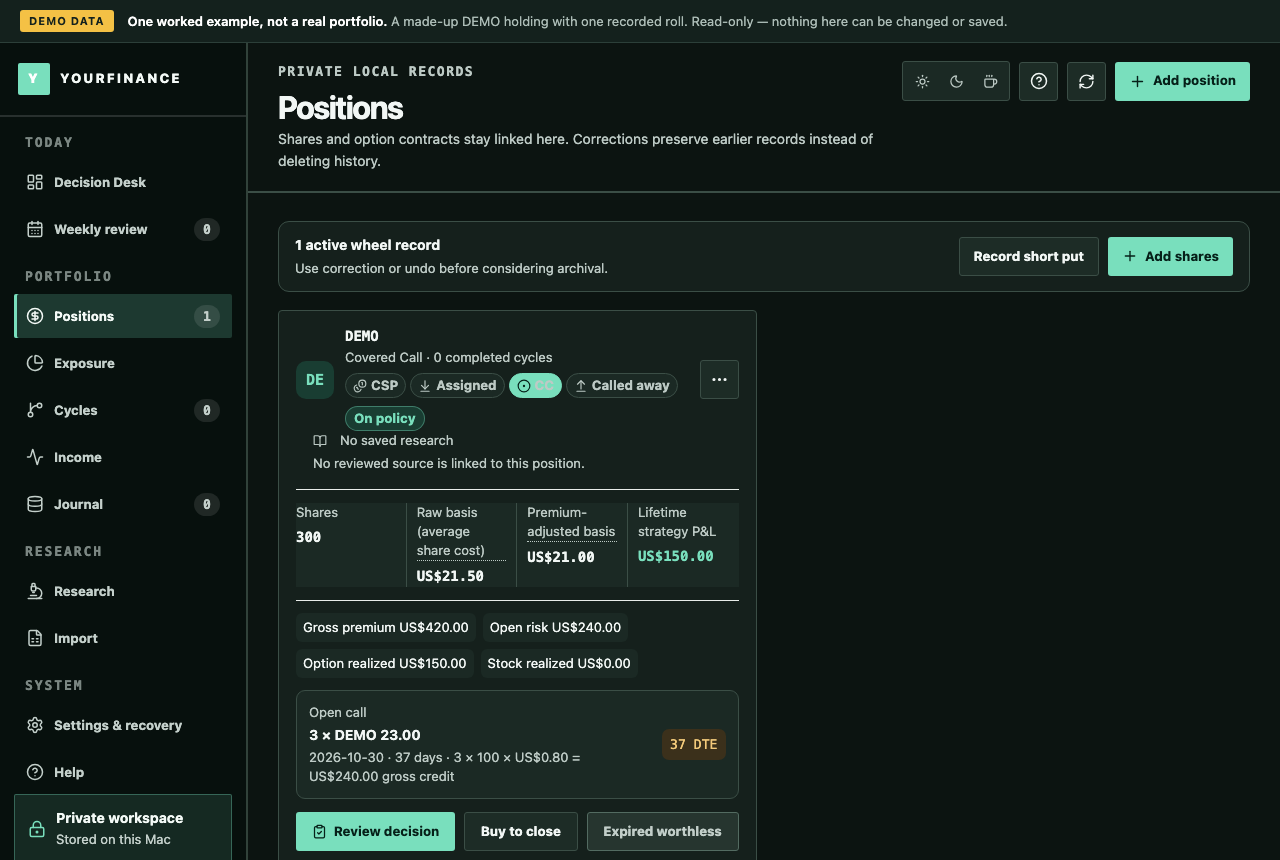
yourfinance keeps two numbers for every share lot: what you paid, and what you paid less the option P&L realized in this cycle. Premium on a call that is still open never lowers your basis, because it can still be lost.
Download
- macOS, Apple Silicon (M1 or later) DMG · Developer ID signed and notarized
- macOS, Intel DMG · Developer ID signed and notarized
- Windows 10 or 11, from the Microsoft Store signed by Microsoft · updates through the Store · no broker connectors
- Windows 10 or 11, 64-bit ZIP · with broker connectors · not code-signed; Windows may warn or block it
Which Mac? Apple menu → About This Mac shows the chip.
How it works
What yourfinance keeps track of
Raw basis is what you paid
Share cost plus the fees you entered, divided by the shares you hold. On a put assignment it starts at the strike times the shares, plus assignment fees.
Only settled option P&L lowers it
When a call is bought back, expires, or is assigned or called away, its opening credit less the closing debit and fees comes off the basis. An open call's credit does not.
Partial call-aways, account by account
When a call takes only part of the lot, its P&L leaves with the shares it covered and that account's earlier premium leaves pro rata. Hold the same ticker in two accounts and premium earned in one never lowers the other's basis; the position shows the combined figure, with each account's own under it.
A new cycle starts clean
When the ticker's last shares are called away, the cycle completes. Shares that arrive later start a new cycle and inherit no premium from the old one, apart from premium still waiting in another account for that account's shares.
Corrections keep the history
Correct a price or a quantity and the cycle's basis is corrected with it. Every correction and undo is kept as an audit event; nothing is deleted.
- Raw basis
- 21.50
- Premium-adjusted basis
- 21.00
- Open premium, not in the basis
- $240
300 shares of a made-up DEMO ticker and one covered-call roll: 150.00 realized ÷ 300 shares = 0.50 a share. Demo data, before fees, not a performance claim.
Counting all 420.00 of premium would lower the basis by 1.40 a share, including 240.00 that is still at risk.
Questions
Questions about this
Why not subtract all the premium I collected?
Because part of it is still at risk. In the demo, 420.00 has been collected, but 240.00 belongs to a call that is still open. Only the 150.00 that settled lowers the basis, so it falls by 0.50 a share, not 1.40.
What happens when shares are called away?
The shares are sold at the strike. Realized stock P&L is the proceeds less the raw cost of the shares sold and the sale fees; the call's own P&L stays a separate number. Both are in the cycle's result.
Does a put that expired before I held shares count?
Yes. Option P&L realized in an account while it held no shares is allocated to that account's shares when they arrive, by assignment or by purchase. A net loss raises the adjusted basis.
Is this the basis my broker or tax office uses?
Not necessarily. Raw basis is what you recorded; the premium-adjusted basis is how the wheel's cycle is tracked. yourfinance is not tax advice: check your broker's statements and your local rules.
Can I correct a mistake?
Yes. Share quantity and price, and an open option's strike, premium, contracts, expiry and fees, can be corrected. A settled option is fixed: undo the latest settlement, then correct. Every change is kept as an audit event.
Try it on your own records
A 10-day free trial with every feature, then read-only until you buy. No account, no card; your records stay on your computer.
Download
- macOS, Apple Silicon (M1 or later) DMG · Developer ID signed and notarized
- macOS, Intel DMG · Developer ID signed and notarized
- Windows 10 or 11, from the Microsoft Store signed by Microsoft · updates through the Store · no broker connectors
- Windows 10 or 11, 64-bit ZIP · with broker connectors · not code-signed; Windows may warn or block it
Which Mac? Apple menu → About This Mac shows the chip.