Income
Premium collected is not profit yet.
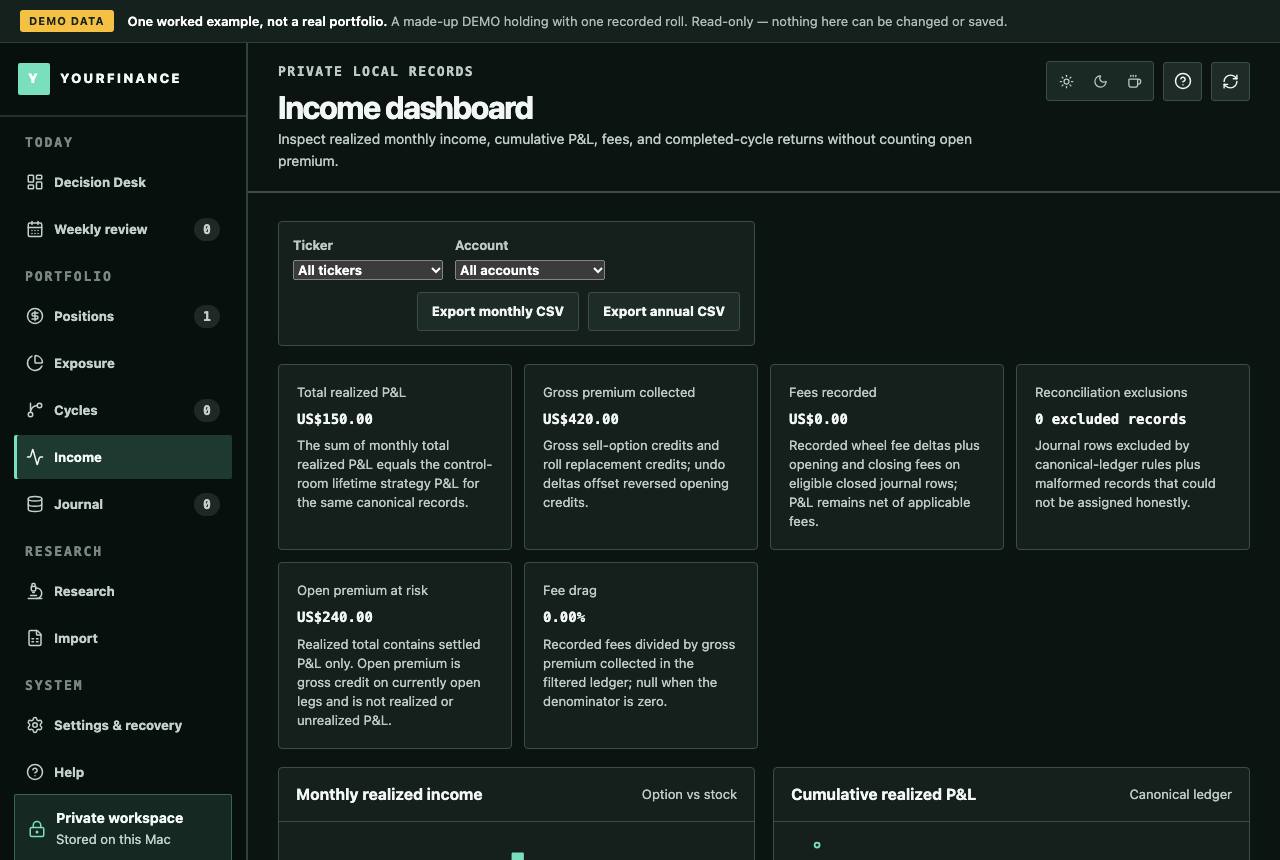
yourfinance keeps three numbers apart: gross premium collected, open premium still at risk, and realized P&L. The income dashboard counts only what has settled.
Download
- macOS, Apple Silicon (M1 or later) DMG · Developer ID signed and notarized
- macOS, Intel DMG · Developer ID signed and notarized
- Windows 10 or 11, from the Microsoft Store signed by Microsoft · updates through the Store · no broker connectors
- Windows 10 or 11, 64-bit ZIP · with broker connectors · not code-signed; Windows may warn or block it
Which Mac? Apple menu → About This Mac shows the chip.
How it works
What yourfinance keeps track of
Gross premium collected
Every short-option opening credit, before closing debits or fees. A roll adds only the replacement credit, and buying back never subtracts from it.
Open premium at risk
The opening credit on options that have not settled. It is not realized, and it is not counted as income.
Realized option P&L
Settled opening credit less the closing debit and option fees. Expiry, assignment, a call-away or a buy-to-close settles an option.
Realized stock P&L, kept apart
Sale proceeds less raw share cost and sale fees; premium is never mixed in. Total realized P&L is the two added together.
By month and by completed cycle
Monthly option and stock P&L, fees, and cumulative realized P&L from the recorded events. An undo counts in its own month, so totals reconcile without rewriting history.
- Premium collected
- $420
- Actually realized
- $150
- Still open, still at risk
- $240
One covered-call roll on a made-up DEMO ticker: 180.00 from the first calls, bought back for 30.00, then 240.00 from the new calls. Demo data, before fees, not a performance claim.
If your spreadsheet reports only the first number, it is not tracking the risk.
Questions
Questions about this
Why is my income lower than the premium I collected?
Because part of that premium belongs to options that are still open. In the demo, 420.00 was collected, 150.00 is realized, and 240.00 is still at risk on the open call.
Where do fees go?
Opening, closing and settlement fees come out of realized P&L. The dashboard shows the fees recorded and the fee drag: fees divided by gross premium collected.
How are returns shown?
A completed cycle's return is its total realized P&L divided by its recorded capital. The simple return comes first. An annualized figure is secondary, labelled hypothetical, and says how many repeats of the term it assumes.
Does an undo rewrite earlier months?
No. An undo adds the opposite change in the month it is recorded, so lifetime totals reconcile and earlier months stay as they were.
Can I export it?
Yes: monthly and annual CSV from the income dashboard, alongside tax-year exports. They are records, not tax advice.
Try it on your own records
A 10-day free trial with every feature, then read-only until you buy. No account, no card; your records stay on your computer.
Download
- macOS, Apple Silicon (M1 or later) DMG · Developer ID signed and notarized
- macOS, Intel DMG · Developer ID signed and notarized
- Windows 10 or 11, from the Microsoft Store signed by Microsoft · updates through the Store · no broker connectors
- Windows 10 or 11, 64-bit ZIP · with broker connectors · not code-signed; Windows may warn or block it
Which Mac? Apple menu → About This Mac shows the chip.